
How to Plan a Family Memory Project Across Generations
Plan a focused family memory project with clear roles, consent, interviews, review, source preservation, private sharing, and a realistic finish line.
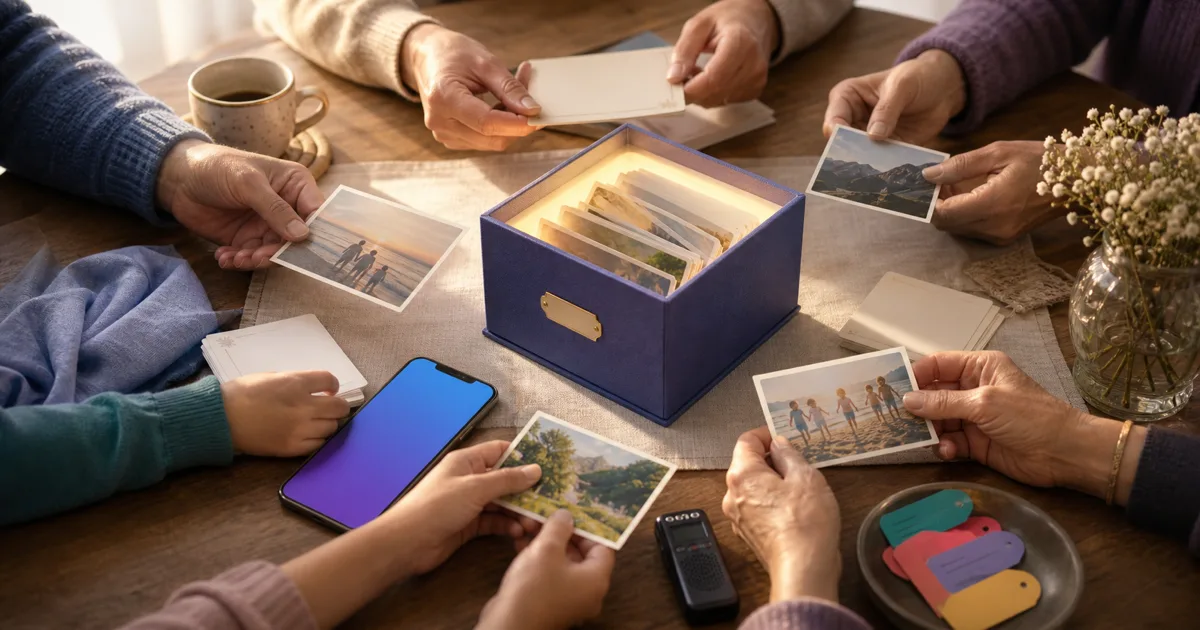
A successful family memory project needs one clear purpose, a named owner, consent boundaries, a small pilot, and a realistic rhythm. Decide whose stories you are preserving, who may contribute or review, what will remain private, where originals and backups live, and what “done for now” means. Then capture focused stories in short cycles rather than attempting a complete family history at once.
This plan works for relatives and for professionals coordinating a legacy, celebrant, family-office, care, or life-story engagement. It does not assume the chosen app has collaboration, approvals, or team administration unless those capabilities have been verified.
Start with a project charter
Keep the charter to one page. It should answer:
| Question | Example decision |
|---|---|
| Purpose | Preserve grandparents' migration and early working-life stories for the immediate family |
| Narrators | Ana and Joseph, interviewed separately and together |
| Audience | Children and grandchildren; no public release during the pilot |
| Outputs | Original audio, reviewed transcripts, 20 StoryBank stories, and a simple photo catalogue |
| Project owner | Maya coordinates sessions and backups |
| Review authority | Each narrator approves their own stories; both review shared events |
| Duration | Twelve weeks, then a pause and review |
| Preservation | Two copies of source files plus a working folder |
| Boundaries | No medical, financial, or third-party conflict stories without a separate decision |
The charter prevents a relative's enthusiastic “let's capture everything” from becoming an open-ended obligation for the narrator.
Define roles without inventing software permissions
A family project can have clear human roles even when the app uses individual accounts.
- Narrator: chooses what to tell and how it may be used.
- Interviewer: prepares and conducts conversations.
- Project owner: maintains schedule, decisions, and handovers.
- Editor: creates readable drafts without changing meaning.
- Identifier: helps name people, places, objects, and dates.
- Steward: holds source files, catalogue, consent notes, and backups.
- Reader or recipient: receives approved stories in the agreed way.
One person may hold several roles, but name them. Hidden ownership causes problems when an account password, hard drive, or project spreadsheet belongs to the only relative who understands the system.
StoryBank currently supports personal accounts and individual story management. Do not represent it as providing shared workspaces, role-based contributor access, or approval queues. If several people will use StoryBank, decide which person owns each account and how reviewed material is transferred without sharing credentials casually.
Choose a focused first collection
Avoid “the complete family history.” Choose a theme that can produce 10 to 20 strong stories:
- A move between countries or towns.
- Working life and learned skills.
- A family business.
- Recipes and celebrations.
- One house across several decades.
- Courtship, partnership, and friendship.
- Childhood games and school.
- A set of inherited photographs.
- Advice, sayings, and traditions.
A focused collection creates momentum and exposes the workflow. The family can add another theme later.
Build a story map, not a questionnaire
Create a table with possible scenes, people, objects, and evidence.
| Story lead | Possible narrator | Prompt object | Context to verify |
|---|---|---|---|
| First week in the new town | Ana | Train ticket | Arrival month and address |
| Learning the bakery ovens | Joseph | Shop photograph | Employer's name and year |
| Sunday lunch for twelve | Both | Recipe card | Who wrote the card |
| The winter the pipes froze | Ana | House exterior | Which winter |
| First family car | Joseph | Car photograph | Model and registration year |
The map is a set of invitations, not a requirement to answer every item. Add a column for “not for this project” when a narrator declines a topic so it is not repeatedly raised.
Agree consent and privacy levels
Use simple, separate choices:
- May this session be recorded?
- May a transcript be produced?
- May family members named in the charter read the draft?
- May the final story be shared more widely?
- May the original recording be shared, or only the edited text?
- Is there a future date or event after which access may change?
Do not bundle private capture and public publication into one vague agreement. Review access story by story because sensitivity varies.
The Oral History Association's ethics statement emphasises informed consent, clear communication of risks and uses, dignity, privacy, and safety. Professional projects should use forms and advice appropriate to their context and jurisdiction.
StoryBank is private by default at the story level, with selected publication controlled by the user. Its privacy policy explains that public stories may be visible and indexed. Begin the pilot privately.
Plan an achievable rhythm
For a twelve-week family project, try:
- Week 1: charter, roles, consent conversation, and technology test.
- Week 2: photograph and document selection.
- Weeks 3–4: first two short interviews.
- Week 5: transcription, story division, and narrator review.
- Weeks 6–8: three more interviews based on what emerged.
- Week 9: identification session for photographs and uncertain details.
- Week 10: edit and review the complete pilot collection.
- Week 11: confirm visibility and create access copies.
- Week 12: backup audit, family handover, and project review.
Build in pauses. A weekly prompt may suit one narrator; another may prefer a concentrated weekend followed by no activity for a month. Consistency should support the person rather than turn memories into homework.
Conduct interviews in short, focused sessions
Forty-five to seventy-five minutes is often sufficient for one or two themes, but follow the narrator's energy and preferences. Prepare a quiet setting, test the recorder, and begin with a concrete prompt.
Ask for scenes:
- What could you see from the window?
- Who arrived first?
- What did you always carry to work?
- What happened when the plan went wrong?
- What do people misunderstand about that time?
- Which detail would you want a grandchild to remember?
End by asking what should happen to the recording and whether any section needs to remain out of the project. The repeatable interview workflow covers preparation, consent, recording, review, and preservation in depth.
Divide sessions into focused stories
A transcript is not automatically a readable archive. One interview may contain six stories. Split at changes of scene, event, or meaning.
For each story, prepare:
- A specific, memorable title.
- A direct opening answer.
- The narrator's perspective and characteristic phrasing.
- Necessary context that a future reader will not know.
- A supported or clearly approximate date.
- Names with uncertain identifications marked.
- One relevant photograph where available.
- Tags for person, place, period, and theme.
- A link back to the source recording reference.
- A private, family, or public access decision.
Do not merge conflicting accounts into a false consensus. Two siblings can have separate stories about the same event, each clearly attributed.
Use StoryBank without losing source context
When a reviewed story is ready:
- Sign in to the narrator's agreed StoryBank account.
- Enter or shape the story from the reviewed material.
- Add the working copy of the relevant photograph.
- Add dates and tags that are supported.
- Keep the entry private while the narrator reviews it in context.
- Record the StoryBank title and related source reference in the catalogue.
- Publish only after a separate decision by the narrator or authorised person.
StoryBank can generate image options when no photograph is available. Treat those as illustrations. Do not let a generated scene be mistaken for a historical photograph or evidence of an event.
If own-voice narration is considered, read StoryBank's terms. Only a user may create a clone of their own voice, with consent. Never use an old recording of someone else to create a model.
Coordinate photographs as their own workstream
Give each image a stable reference and retain the physical order and inscriptions. Scan a master, create a working copy, and collect identification separately from the story text.
Ask multiple relatives independently where useful. Record disagreement instead of letting the most confident person overwrite everyone else. The searchable family photo archive guide provides a full catalogue and scanning method.
Define “done for now”
Close a phase when:
- The target stories have been captured and reviewed.
- Every source file has a stable reference and two copies.
- Visibility decisions are complete.
- Account and archive ownership have been handed over.
- Outstanding uncertainties are documented.
- The family knows how to add the next story.
- A review date is scheduled.
Closure creates trust. The project can reopen later without feeling abandoned.
Conclusion
A multi-generation memory project succeeds through clear ownership, respectful consent, focused themes, short cycles, and reliable stewardship. Choose a modest first collection, preserve source files independently, and let narrators approve both wording and access.
When the family wants an ongoing home for the reviewed stories, create a StoryBank account or download the app. For the long-term view, continue with Digital Legacy and Life Story Preservation.