
Digital Legacy and Life Story Preservation: A Practical Guide
Build a durable digital legacy from stories, source media, context, permissions, independent copies, and a stewardship plan another person can follow.
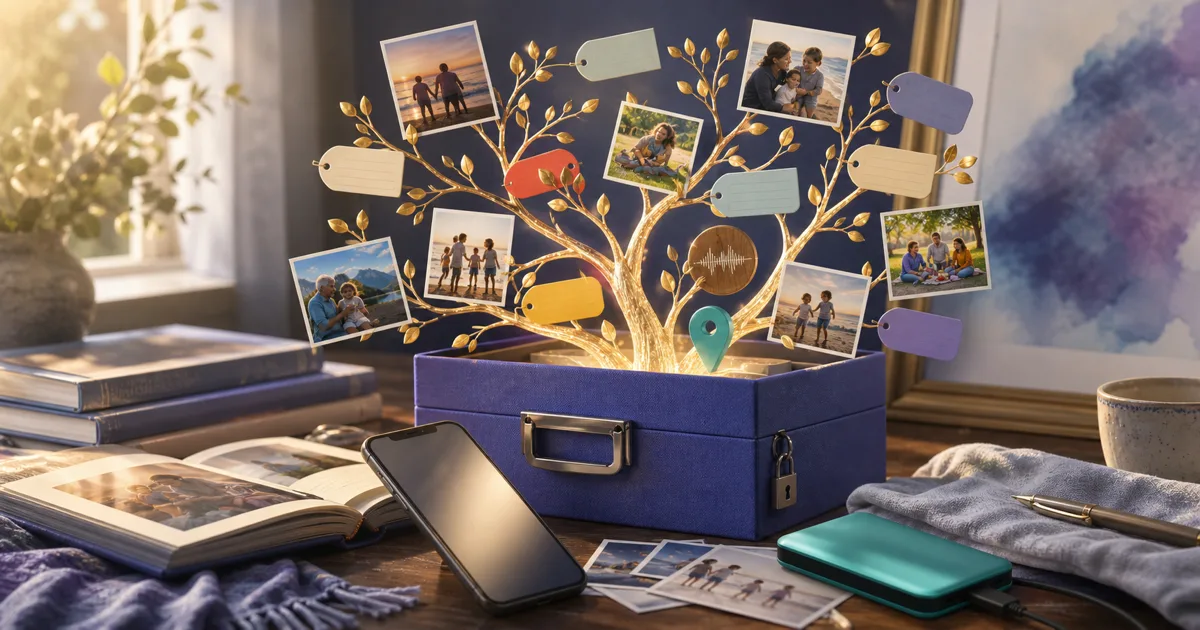
A durable digital legacy is not a single account or a folder of photographs. It is a maintained set of stories, source media, context, permissions, access instructions, and independent copies that another person can understand. Life story preservation adds the human work: interviewing, editing faithfully, identifying people and places, and deciding what should remain private or be shared.
For families and professional advisers, the goal is continuity without overpromising permanence. Stewardship keeps memories usable when devices, services, and family circumstances change.
What belongs in a digital legacy
The term can cover online accounts, financial assets, creative work, messages, social profiles, photographs, and personal records. This guide focuses on the life-story layer:
- Written memories and transcripts.
- Original audio and video interviews.
- Photographs, documents, and captions.
- Dates, places, people, and relationships.
- Recipes, traditions, sayings, skills, and values.
- Access and publication decisions.
- Account recovery and stewardship instructions.
- A catalogue that links stories to sources.
The most valuable item may be an ordinary explanation: who is in a photograph, why a recipe changed, or what happened on the journey home. Context is usually harder to recreate than the file itself.
The six-part preservation model
| Part | Core question |
|---|---|
| Story | What happened, and why did it matter to the narrator? |
| Source | What original recording, image, or document supports it? |
| Context | Who, where, when, and how certain are those details? |
| Rights | Who owns it, who consented, and who may access it? |
| Copies | Where are independent preservation and working copies? |
| Stewardship | Who will maintain, review, and hand it on? |
An app page without sources is fragile; a drive of masters without context is unintelligible. The model needs both.
Life story preservation is a process, not a product
Software can prompt, transcribe, organise, narrate, and present. It cannot decide whether a narrator felt pressured or a public story exposes another person.
The Oral History Association's core principles emphasise respect for narrators, transparency, ongoing participation, consent, and sensitivity to differences in power. Its guidance applies most directly to oral-history practice, but the underlying discipline improves family and professional legacy projects too.
Use a repeatable cycle:
- Define purpose and audience.
- Agree capture and access with the narrator.
- Record or write a focused memory.
- Preserve the original source.
- Edit and add context without changing meaning.
- Let the narrator review where possible.
- Publish or share only through a separate decision.
- Update the catalogue and backups.
Start with stories that only this person can tell
Do not begin by attempting a complete chronology. Ask for scenes that combine fact, sensory detail, and interpretation:
- A room they remember clearly.
- A task they learned from someone else.
- The journey to a first job.
- An ordinary meal that defined home.
- A mistake that became family folklore.
- The history behind one photograph.
- A tradition they hope continues.
- A decision that looks different in hindsight.
These stories are valuable because they preserve perspective, not because they summarise every year. A collection of 20 focused accounts is often more usable than one unedited, all-day recording.
The life story interview workflow provides questions, setup, consent, and review steps.
Keep originals, masters, and access copies distinct
An original interview recording is different from a transcript. A master scan is different from a cropped app image. Generated narration is different from the narrator speaking during an interview.
Use clear labels:
| File or object | Role |
|---|---|
| Physical photograph | Original object; preserve inscriptions and order |
| Master scan | High-quality preservation copy with minimal alteration |
| Working image | Cropped or compressed copy for presentation |
| Original audio | Source recording of what the narrator actually said |
| Transcript | Searchable representation of the recording |
| Edited story | Curated text for readers |
| Generated narration | Synthetic playback of edited text |
The Library of Congress's personal digital archiving resources cover scanning, descriptions, file formats, and the importance of personal preservation. Its scanning guidance recommends keeping a master and separate working copy.
Make context portable
Do not leave all meaning inside one app's interface. Maintain a simple catalogue in a widely readable format such as CSV, with documentation explaining the columns.
Useful fields include:
- Stable reference.
- Title.
- Narrator or creator.
- People and relationships.
- Place.
- Date and certainty.
- Short description.
- Related source filenames.
- Rights holder or supplier.
- Consent reference.
- Access level.
- App or publication URL.
- Notes and unresolved questions.
Stable references let a future steward connect SB-ST-0018 in the catalogue to audio, photographs, transcript, and a StoryBank entry even if filenames or services later change.
Design privacy as layers
Avoid a binary assumption that a legacy must be either secret or public. Use layers:
- Private working material: unreviewed recordings, drafts, sensitive notes.
- Personal archive: material available only to the narrator or account holder.
- Named family access: approved stories for a defined group.
- Future release: restricted now with a documented review date or condition.
- Public collection: deliberately published material suitable for open access.
Review each story. A public childhood anecdote does not imply permission to publish a health history or an account involving living relatives.
StoryBank supports private stories and deliberate publication of selected entries. Its privacy policy warns that public story and profile data may be visible on the web, indexed, and shared. Once a recipient has copied something, changing the original visibility cannot guarantee retrieval.
Handle voice with precise language
Voice is emotionally important and technically easy to misunderstand.
Original voice recording
This is the narrator speaking at a particular moment. It preserves delivery, pauses, accent, emotion, and exact wording. Keep it as a source when consent and the project plan allow.
Transcription
This converts speech to text. It improves search and editing, but it can mishear names, places, dialect, and overlapping speech. Review it against the source.
Text-to-speech narration
This reads a prepared text aloud. It improves access but is not evidence that the narrator spoke those exact sentences.
Voice cloning
This creates a voice model for generated speech. It requires explicit, informed consent and careful provider review. StoryBank allows an optional user-created clone of the user's own voice for playback. Its terms prohibit cloning another person's voice and its privacy policy explains provider processing and deletion controls.
Label generated audio clearly. Never replace an original recording with synthetic narration and then describe the result as “their recording.”
Use StoryBank as an access and story layer
StoryBank brings together the parts a reader needs: a focused story, image, date, tags, profile context, and visibility choice. Users can capture by typing or voice, work through guided chat, and revisit stories through a personal archive. Story playback and optional own-voice narration add listening. Published stories can contribute to a Digital Twin that answers from those saved memories.
That makes StoryBank useful for:
- Building an archive gradually.
- Keeping photographs with their explanations.
- Turning interviews into readable entries.
- Choosing which stories remain private.
- Sharing selected public stories on attractive pages.
- Offering narration and memory-grounded discovery.
It does not remove the need for source preservation, export planning, consent records, or professional repository systems. StoryBank's terms explicitly state that no online service can guarantee uninterrupted or permanent storage and advise users to keep their own copies.
Build a backup that can survive the app
Use more than one copy and more than one failure mode. A practical family arrangement might include:
- The working collection on the organiser's computer.
- An encrypted external drive stored separately.
- A reputable cloud backup controlled by the family.
- Periodic exports of catalogue and story text.
- Printed or PDF access copies for selected material.
Do not expose private archives through poorly configured shared folders. Encrypt sensitive portable media, enable strong account authentication, and document recovery information in a secure estate or continuity plan rather than in the archive itself.
Evaluate platforms with a continuity scorecard
Before using any life-story service, require:
- A contribution method the narrator can use.
- Understandable private and public controls.
- A review route for transcript and story accuracy.
- Download or independent retention of essential sources.
- Clear processing information for voice and generated media.
- Account recovery and support routes.
- A commercial model the family can maintain.
- An exit plan that does not depend on the provider remaining unchanged.
The present shutdown notice on HereAfter AI's website shows why this matters. See the HereAfter migration guide for a source-first recovery workflow.
Conclusion
Digital legacy and life story preservation combine human trust with technical continuity. Capture focused memories, keep originals distinct from edited and generated material, carry context in a portable catalogue, layer access, name a steward, and maintain independent copies.
StoryBank can become the engaging story layer within that system: private by default, structured around images and context, selectively shareable, and accessible through narration and memory-grounded chat. Explore StoryBank, create an account, and use the life story app buyer's guide to test the fit before entrusting it with the full collection.